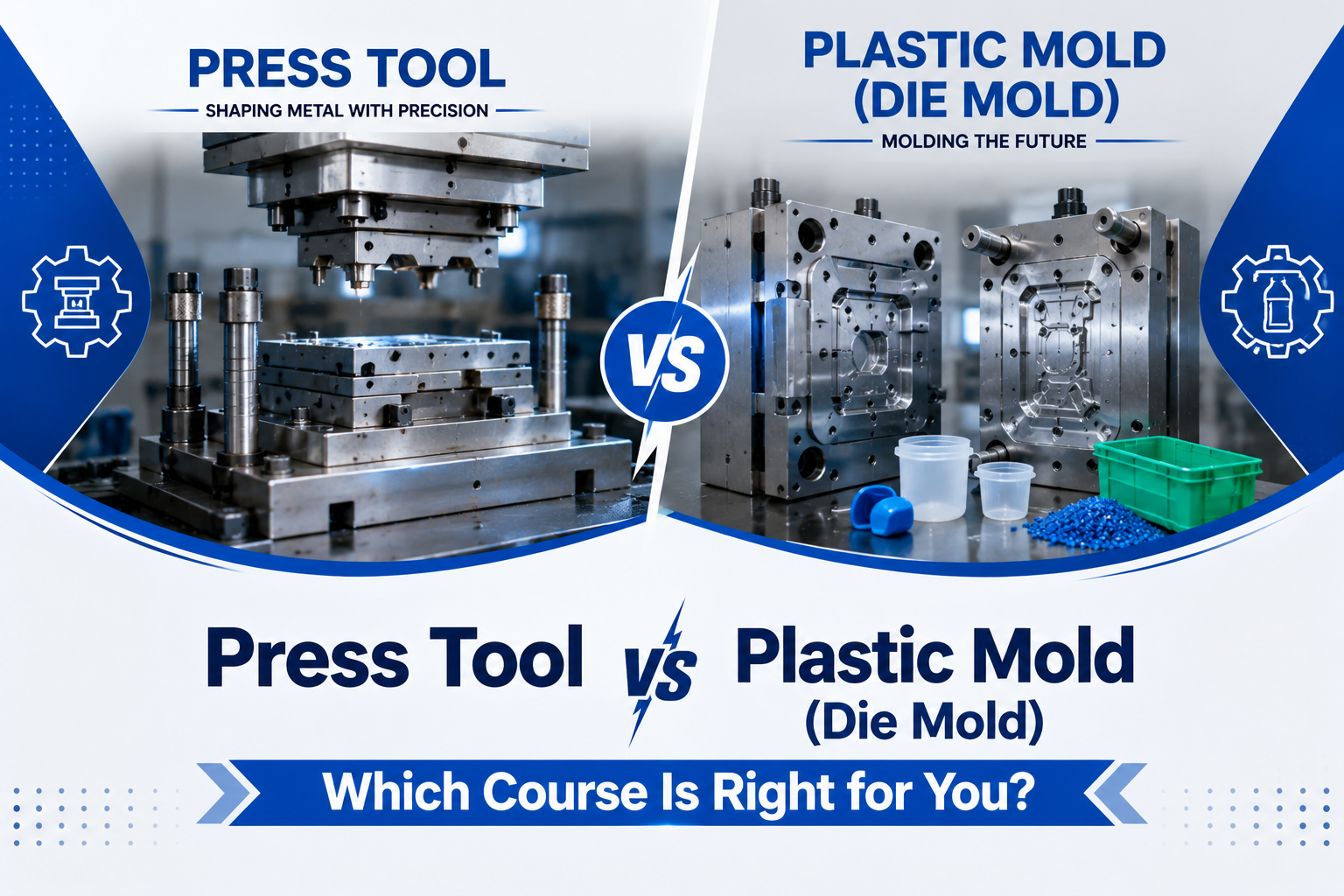
The manufacturing industry is one of the fastest-growing sectors worldwide, creating thousands of job opportunities every year. As industries adopt advanced production technologies, the demand for skilled professionals in tool room engineering continues to rise. Two of the most popular and rewarding career paths in this field are Press Tool and Plastic Mold (Die Mold).
Many students completing ITI, Diploma, Mechanical Engineering, or Production Engineering often ask:
- Which course has better career opportunities?
- Is Press Tool better than Plastic Mold?
- Which course offers a higher salary?
- Which field has more demand in India and abroad?
The truth is that both courses provide excellent career opportunities, but they focus on different manufacturing processes and industries.
This comprehensive guide compares Press Tool and Plastic Mold (Die Mold) courses in detail, helping you choose the right career path based on your interests, skills, and long-term goals.
What Is a Press Tool Course?
A Press Tool Course focuses on designing, manufacturing, assembling, and maintaining tools used for shaping sheet metal into finished products. Press tools are used in conjunction with power presses to cut, bend, punch, pierce, blank, emboss, and form metal components with high precision.
Students receive practical training in:
- Press Tool Design
- Sheet Metal Processing
- Punch & Die Manufacturing
- Tool Assembly
- Tool Maintenance
- Grinding Operations
- Milling
- Lathe Operations
- Surface Grinding
- CNC Machining
- Engineering Drawing
- Precision Measurement
Press tool manufacturing is widely used for mass production of metal components.
What Is a Plastic Mold (Die Mold) Course?
A Plastic Mold (Die Mold) Course focuses on the design and manufacturing of molds used for plastic injection molding. Plastic molds are essential for producing high-quality plastic products with consistency and precision.
Students learn:
- Injection Mold Design
- Core and Cavity Design
- Mold Assembly
- Mold Maintenance
- CAD/CAM Software
- CNC Programming
- EDM Machining
- Wire Cut EDM
- VMC Machining
- Mold Testing
- Product Development
Plastic molding has become one of the most important manufacturing technologies due to the growing use of plastic products in everyday life.
Press Tool vs Plastic Mold: Understanding the Difference
Although both belong to the tool room industry, they differ significantly in the materials they process and the manufacturing methods they use.
| Feature | Press Tool | Plastic Mold (Die Mold) |
|---|---|---|
| Material | Sheet Metal | Plastic |
| Manufacturing Process | Pressing, Punching, Blanking, Forming | Injection Molding |
| Production Equipment | Power Presses | Injection Molding Machines |
| Main Product | Metal Components | Plastic Components |
| Primary Industries | Automotive, Electrical, Sheet Metal | Automotive, Packaging, Medical, Consumer Goods |
Industries That Hire Press Tool Professionals
Press Tool professionals are in demand across industries such as:
Automotive Manufacturing
Manufacturing:
- Body Panels
- Chassis Parts
- Brackets
- Clips
- Mounting Plates
Electrical Equipment
Production of:
- Electrical Cabinets
- Switch Components
- Connectors
- Metal Enclosures
Home Appliances
Manufacturing:
- Washing Machine Parts
- Refrigerator Panels
- Microwave Components
- Air Conditioner Parts
Industrial Machinery
Production of:
- Machine Covers
- Mounting Brackets
- Industrial Fixtures
Industries That Hire Plastic Mold Professionals
Plastic mold professionals work in rapidly expanding industries.
Automotive Industry
Manufacturing:
- Dashboard Components
- Bumpers
- Door Panels
- Interior Trims
Medical Equipment
Production of:
- Syringes
- Medical Containers
- Surgical Equipment
- Laboratory Products
Consumer Goods
Manufacturing:
- Plastic Bottles
- Storage Containers
- Kitchen Products
- Toys
Packaging Industry
Manufacturing:
- Food Containers
- Cosmetic Packaging
- Pharmaceutical Packaging
- Industrial Packaging
Electronics Industry
Production of:
- Mobile Phone Covers
- Laptop Components
- TV Frames
- Electrical Housings
Skills Learned in a Press Tool Course
Students develop practical expertise in:
- Sheet Metal Design
- Press Tool Assembly
- Punch Manufacturing
- Die Manufacturing
- Surface Grinding
- Milling Operations
- Lathe Machining
- Precision Measurement
- Tool Maintenance
- Tool Inspection
- Production Planning
- Workshop Safety
These skills prepare students for high-volume metal manufacturing.
Skills Learned in a Plastic Mold Course
Students gain knowledge in:
- Mold Design
- Injection Mold Manufacturing
- Core and Cavity Development
- CAD/CAM Software
- CNC Machining
- EDM Operations
- Wire Cut EDM
- Mold Polishing
- Mold Assembly
- Mold Testing
- Product Development
- Quality Inspection
These skills are highly valued in modern plastic manufacturing.
Career Opportunities After a Press Tool Course
Graduates can work as:
Press Tool Technician
Responsible for manufacturing and maintaining press tools.
Tool Room Technician
Works on precision tooling and machine operations.
Tool Maker
Manufactures punches, dies, and forming tools.
Production Engineer
Supervises sheet metal production processes.
Quality Inspector
Ensures dimensional accuracy of manufactured components.
Maintenance Technician
Maintains press tools and production equipment.
Career Opportunities After a Plastic Mold Course
Students can build careers as:
Mold Technician
Manufactures and maintains injection molds.
Mold Designer
Designs molds using CAD software.
CNC Programmer
Programs CNC machines for mold manufacturing.
EDM Operator
Specializes in Electrical Discharge Machining.
VMC Operator
Performs precision machining on mold components.
Product Development Engineer
Develops new plastic products for manufacturing.
Salary Comparison
Salary depends on skills, experience, and company.
Press Tool Career
Freshers:
₹15,000–₹22,000/month
Experienced Professionals:
₹30,000–₹60,000/month
Senior Tool Room Engineers:
₹70,000–₹1,20,000+/month
Plastic Mold Career
Freshers:
₹18,000–₹25,000/month
Experienced Professionals:
₹35,000–₹70,000/month
Senior Mold Designers:
₹80,000–₹1,50,000+/month
Professionals with CAD/CAM and mold design expertise often command higher salaries due to the complexity of mold manufacturing.
Which Course Has Better Future Scope?
Both fields offer excellent long-term opportunities.
Press Tool Industry Growth
Demand remains strong because sheet metal components are essential in:
- Automotive
- Electrical
- Industrial Equipment
- Construction
- Railways
Plastic Mold Industry Growth
Plastic product demand continues to increase due to:
- Consumer Products
- Medical Devices
- Electronics
- Packaging
- Automotive Interiors
- Electric Vehicles
With sustainable plastics and advanced polymers gaining popularity, mold manufacturing is expected to grow significantly.
Which Course Is Easier to Learn?
Both courses require:
- Mechanical aptitude
- Precision
- Patience
- Practical training
- Problem-solving skills
Students who enjoy working with metal fabrication may prefer Press Tool, while those interested in precision mold making and product development may find Plastic Mold more engaging.
Importance of Practical Training
Theory introduces concepts, but practical experience is what makes students industry-ready.
Hands-on training helps students:
- Operate CNC and VMC machines
- Use measuring instruments
- Read engineering drawings
- Assemble tools and molds
- Troubleshoot manufacturing issues
- Follow safety procedures
Employers value candidates who have worked on real industrial projects during their training.
Software Used in Both Courses
Modern tool room professionals often work with:
- AutoCAD
- SolidWorks
- CATIA
- NX CAD
- Mastercam
- PowerMill
- Fusion 360
- CAM Software
Learning these tools enhances job prospects and opens doors to design-oriented roles.
Who Should Choose a Press Tool Course?
A Press Tool Course is ideal for:
- ITI students
- Diploma holders
- Mechanical engineering students
- Production engineering graduates
- Students interested in sheet metal manufacturing
- Individuals aiming for tool room careers
Who Should Choose a Plastic Mold Course?
A Plastic Mold Course is suitable for:
- Mechanical engineering students
- Tool and Die Making students
- Diploma holders
- Professionals interested in mold design
- Students passionate about CAD/CAM
- Individuals seeking careers in plastic manufacturing
Can You Learn Both?
Yes. In fact, many leading tool room professionals gain expertise in both Press Tool and Plastic Mold technologies.
Learning both courses offers several advantages:
- More job opportunities
- Better salary potential
- Broader technical knowledge
- Greater flexibility across industries
- Faster career growth into supervisory or design roles
A professional with skills in both metal forming and plastic molding is highly valuable in modern manufacturing.
How to Choose the Right Course
When deciding between Press Tool and Plastic Mold, consider:
Choose Press Tool if you:
- Enjoy working with sheet metal
- Want to specialize in stamping and forming operations
- Prefer careers in automotive and heavy engineering
- Like mechanical tooling and die manufacturing
Choose Plastic Mold if you:
- Are interested in precision mold making
- Want to work with injection molding technology
- Enjoy CAD/CAM and product development
- Aim for careers in consumer products, electronics, or medical manufacturing
Your choice should align with your interests, career goals, and the type of manufacturing environment you want to work in.
Final Thoughts
Choosing between a Press Tool Course and a Plastic Mold (Die Mold) Course is not about selecting the “better” option—it is about selecting the course that best matches your interests and career aspirations.
Press Tool technology is the backbone of sheet metal manufacturing, powering industries such as automotive, electrical equipment, and industrial machinery. Plastic Mold technology drives the production of countless products used every day, from medical devices and electronics to packaging and automotive interiors.
Both fields offer strong demand, competitive salaries, and excellent career growth. With quality practical training, exposure to modern CNC and VMC machining, and continuous skill development, you can build a successful and rewarding career in the manufacturing industry.
If you’re passionate about engineering, precision, and creating products that shape the modern world, either course can provide a solid foundation for a long-term career in advanced manufacturing.
Frequently Asked Questions (FAQs)
1. Which course is better: Press Tool or Plastic Mold?
Both are excellent options. Press Tool is ideal for sheet metal manufacturing, while Plastic Mold is best for injection molding and plastic product manufacturing.
2. Which course has better salary potential?
Both offer competitive salaries. Professionals with advanced skills in mold design, CAD/CAM, CNC programming, or tool room management generally earn higher packages as they gain experience.
3. Can Diploma and ITI students join these courses?
Yes. Both Press Tool and Plastic Mold courses are suitable for ITI graduates, diploma holders, mechanical engineering students, and fresh graduates seeking practical manufacturing skills.
4. Is practical training important for these courses?
Absolutely. Practical training on CNC, VMC, EDM, and tool room machines is essential for becoming job-ready and meeting industry expectations.
5. Can I pursue both Press Tool and Plastic Mold training?
Yes. Learning both disciplines broadens your technical expertise, increases employability, and provides greater career flexibility across multiple manufacturing industries.