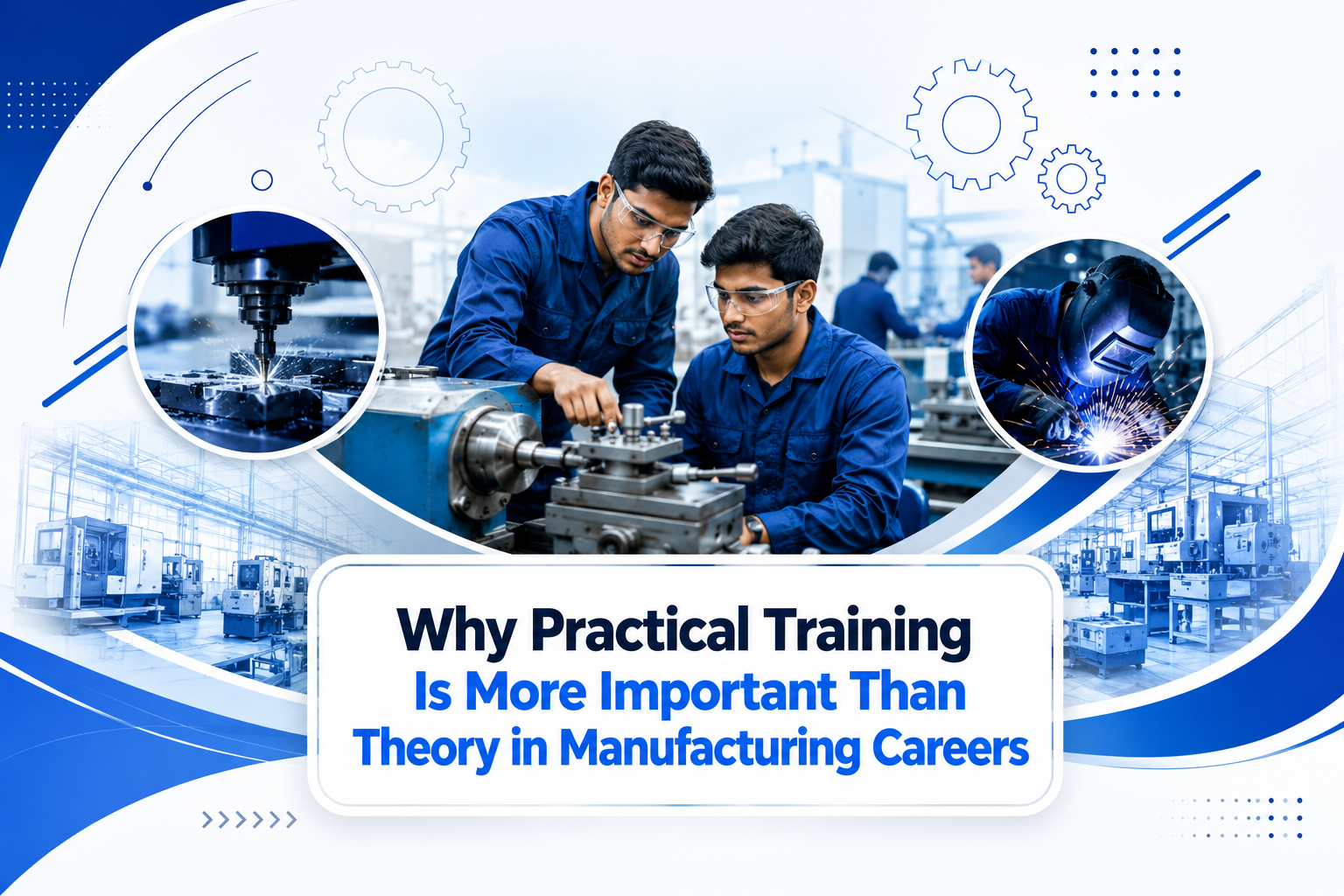
The manufacturing industry is evolving faster than ever before. Modern factories rely on advanced CNC machines, VMC machining centers, CAD/CAM software, automation systems, robotics, and precision measuring instruments. While classroom education provides the theoretical foundation, employers today are looking for candidates who can confidently operate machines, solve real-world production challenges, and contribute from day one.
This is why practical training in manufacturing careers has become one of the most important factors for students and fresh engineering graduates.
Whether you’re pursuing mechanical engineering, production engineering, diploma studies, ITI, or technical vocational education, hands-on industrial training bridges the gap between classroom knowledge and industry expectations.
In this comprehensive guide, we’ll explore why practical training matters more than theoretical learning, the benefits it offers, and how it helps students build successful manufacturing careers.
Understanding the Difference Between Theory and Practical Training
Before discussing their importance, it’s essential to understand the difference between theoretical education and practical learning.
Theory-Based Learning
Theory focuses on:
- Engineering concepts
- Manufacturing principles
- Machine design
- Material science
- Engineering mathematics
- Industrial processes
- Technical calculations
Theory helps students understand why manufacturing processes work.
Practical Training
Practical training focuses on:
- Operating industrial machines
- Reading engineering drawings
- Machine setup
- Measuring components
- Tool selection
- Safety procedures
- Production workflow
- Troubleshooting machine issues
Practical learning teaches students how manufacturing actually happens.
Both are important, but industries increasingly value practical experience because it directly impacts productivity and quality.
Why Manufacturing Industries Prefer Practical Skills
Manufacturing companies invest significant resources in hiring and training employees. They prefer candidates who already possess practical exposure because it reduces:
- Training costs
- Machine downtime
- Production errors
- Material wastage
- Safety risks
An employee who already knows machine operations can contribute much sooner than someone who only understands textbook concepts.
This is why employers often prioritize candidates who have completed industrial practical training programs.
The Growing Skills Gap in Manufacturing
One of the biggest challenges faced by industries today is the gap between academic education and industrial requirements.
Many engineering graduates possess:
- Strong theoretical knowledge
- Good academic scores
- Understanding of engineering formulas
But they often lack experience in:
- Operating CNC machines
- VMC programming
- Tool setting
- Precision measurement
- Machine maintenance
- Industrial safety
- Production planning
Practical training fills this gap by preparing students for actual manufacturing environments.
Benefits of Practical Training in Manufacturing Careers
1. Real Industry Experience
Classroom education cannot fully replicate industrial environments.
Practical training allows students to experience:
- Factory workflow
- Machine operations
- Production scheduling
- Team collaboration
- Quality inspections
- Industrial discipline
This exposure builds confidence before entering the workforce.
2. Better Understanding of Machines
Students gain hands-on experience with machines such as:
- CNC Turning Machines
- CNC Milling Machines
- VMC Machines
- Lathe Machines
- Surface Grinders
- Milling Machines
- Drilling Machines
- EDM Machines
- Hydraulic Presses
Learning directly on industrial equipment develops technical competence that textbooks cannot provide.
3. Improved Problem-Solving Skills
Manufacturing involves unexpected challenges every day.
Examples include:
- Incorrect dimensions
- Tool wear
- Machine vibration
- Surface finish issues
- Programming errors
- Material defects
Practical training teaches students how to identify, analyze, and solve these issues efficiently.
4. Strong Technical Confidence
Many graduates feel nervous during their first job because they have never worked with industrial machines.
Hands-on learning eliminates this fear.
Students become comfortable with:
- Machine controls
- Tool handling
- Measuring instruments
- Production processes
- Machine setup
Confidence directly improves workplace performance.
Practical Training Improves Employability
Employers often ask fresh candidates questions like:
- Have you operated a CNC machine?
- Can you read engineering drawings?
- Do you know GD&T basics?
- Have you worked with measuring instruments?
- Can you perform machine setup?
Students with practical experience answer these questions confidently.
As a result, they have better chances of:
- Campus placements
- Walk-in interviews
- Apprenticeships
- Industrial jobs
- Career advancement
Learning CNC and VMC Machines
Today’s manufacturing industry relies heavily on CNC and VMC technology.
Practical CNC training includes:
- Machine programming
- Tool offset
- Workpiece setting
- Tool changing
- Cycle execution
- Quality inspection
- Error correction
VMC practical training focuses on:
- Vertical machining operations
- Fixture setup
- Tool selection
- Multi-axis machining
- Precision manufacturing
These skills are highly valued by employers across industries.
Importance of Engineering Drawing Interpretation
Engineering drawings are the language of manufacturing.
Students learn how to:
- Read dimensions
- Understand tolerances
- Interpret symbols
- Follow production instructions
- Identify machining requirements
Without practical exposure, many students struggle to convert drawings into finished products.
Hands-on practice makes this process much easier.
Measuring Instruments: A Critical Practical Skill
Manufacturing demands accuracy.
Students learn to use:
- Vernier Calipers
- Micrometers
- Height Gauges
- Dial Indicators
- Bore Gauges
- Surface Plates
- Slip Gauges
Practical measurement skills ensure product quality and reduce production defects.
Machine Safety Cannot Be Learned Only Through Books
Industrial safety is one of the most important aspects of manufacturing.
Practical training teaches:
- Personal Protective Equipment (PPE)
- Machine guarding
- Lockout procedures
- Emergency stop systems
- Safe tool handling
- Fire safety
- Workshop discipline
These experiences help students develop safe working habits.
Exposure to Modern Manufacturing Technologies
Manufacturing today involves advanced technologies including:
- CAD/CAM Software
- CNC Automation
- Robotics
- Industry 4.0
- IoT-enabled Machines
- PLC Automation
- Smart Manufacturing
- Digital Inspection Systems
Practical institutes expose students to these technologies before they enter industry.
Better Understanding of Production Processes
Manufacturing is more than operating machines.
Students learn complete production cycles including:
- Material selection
- Job planning
- Machine setup
- Machining operations
- Inspection
- Assembly
- Packaging
- Dispatch
This holistic understanding prepares them for leadership roles in the future.
Practical Training Enhances Communication Skills
Industrial training also develops soft skills such as:
- Teamwork
- Communication
- Time management
- Reporting
- Discipline
- Responsibility
- Leadership
Employers highly value these professional skills.
Reduced Learning Curve During Employment
Companies prefer employees who require minimal training.
Practical learning helps students:
- Adapt quickly
- Understand workplace culture
- Follow production standards
- Meet quality expectations
- Work independently
This significantly reduces onboarding time.
Higher Salary Opportunities
Candidates with practical skills often receive better salary offers compared to candidates with only academic knowledge.
Industries value individuals who can:
- Increase productivity
- Reduce machine downtime
- Maintain quality
- Solve production problems
Practical expertise directly contributes to organizational success.
Better Career Growth
Hands-on experience opens opportunities in roles such as:
- CNC Programmer
- VMC Operator
- Tool Room Engineer
- Production Engineer
- Quality Engineer
- Maintenance Engineer
- Manufacturing Supervisor
- Process Engineer
- CAD/CAM Engineer
These careers offer excellent growth potential.
Practical Training Builds Industry Confidence
Many students hesitate during interviews because they lack industrial exposure.
Practical training prepares students for:
- Technical interviews
- Machine demonstrations
- Trade tests
- Practical assessments
- Shop-floor evaluations
Confidence often becomes the deciding factor during recruitment.
Learning Through Real Projects
Instead of simply studying manufacturing concepts, students work on real industrial projects.
Examples include:
- Machining precision components
- Manufacturing dies
- Press tool development
- Plastic mold manufacturing
- Production fixtures
- Industrial assemblies
Project-based learning strengthens practical understanding.
Industry Exposure Creates Better Professionals
Students interact with:
- Experienced engineers
- Machine operators
- Supervisors
- Quality inspectors
- Production managers
Learning from industry professionals provides valuable insights that books cannot offer.
Importance of Tool Room Training
Tool room training is one of the most valuable practical experiences for manufacturing students.
Students learn:
- Press Tool Design
- Die Manufacturing
- Plastic Mold Making
- Jig and Fixture Design
- Precision Machining
- Tool Maintenance
These specialized skills are always in demand.
Common Skills Developed Through Practical Manufacturing Training
Students typically develop expertise in:
- CNC Programming
- VMC Operations
- Machine Setup
- Tool Selection
- CAD/CAM Basics
- Measuring Instruments
- Workshop Safety
- Production Planning
- Quality Inspection
- Engineering Drawing Reading
- Machine Maintenance
- Industrial Documentation
These competencies significantly improve employability.
How Practical Training Prepares Students for Industry 4.0
Manufacturing is moving toward smart factories.
Students need practical exposure to:
- Digital Manufacturing
- CNC Automation
- AI-Assisted Manufacturing
- Robotics
- Data Monitoring
- Smart Production Systems
Practical institutes introducing Industry 4.0 concepts give students a competitive advantage.
Choosing the Right Practical Training Institute
When selecting a manufacturing training institute, consider:
Industry-Level Machines
Choose institutes equipped with modern CNC and VMC machines.
Experienced Trainers
Learn from instructors with real industrial experience.
Hands-on Learning
Prioritize institutes offering maximum practical exposure.
Small Batch Sizes
Smaller batches ensure personalized attention.
Placement Assistance
Institutes with strong industry connections improve job opportunities.
Updated Curriculum
Training should align with current manufacturing technologies.
Who Should Join Practical Manufacturing Training?
Practical training is beneficial for:
- Mechanical Engineering Students
- Diploma Students
- ITI Students
- Production Engineering Students
- Tool & Die Students
- Fresh Graduates
- Job Seekers
- Working Professionals Looking to Upgrade Skills
The Future of Manufacturing Belongs to Skilled Professionals
The manufacturing industry is becoming increasingly technology-driven.
Companies no longer seek employees who simply understand engineering theory.
They want professionals who can:
- Operate advanced machinery
- Solve production problems
- Maintain quality standards
- Improve productivity
- Work safely
- Adapt to new technologies
Practical training creates industry-ready professionals capable of meeting these expectations.
Final Thoughts
Theory forms the foundation of engineering education, but practical training transforms knowledge into real-world skills. In today’s competitive manufacturing sector, hands-on experience is no longer optional it is essential.
Students who invest in practical learning gain confidence, develop technical expertise, improve employability, and become valuable assets to manufacturing companies. Whether it’s CNC machining, VMC operations, tool room training, engineering drawing interpretation, or quality inspection, every practical skill contributes to long-term career success.
If your goal is to build a rewarding career in manufacturing, don’t stop at classroom education. Choose an institute that emphasizes real industrial exposure, practical workshops, and project-based learning. The combination of theory and hands-on experience will prepare you not just to get a job, but to excel in the manufacturing industry for years to come.
Frequently Asked Questions (FAQs)
1. Why is practical training important in manufacturing careers?
Practical training helps students develop real-world technical skills, operate industrial machines, solve production problems, and become job-ready.
2. Is theory enough to get a manufacturing job?
Theory provides foundational knowledge, but most employers prefer candidates with hands-on industrial experience and machine operation skills.
3. Which practical skills are most valuable in manufacturing?
CNC programming, VMC operation, engineering drawing reading, measuring instruments, CAD/CAM basics, quality inspection, and machine safety are among the most valuable skills.
4. Does practical training improve placement opportunities?
Yes. Students with industrial practical training are generally more confident in interviews and have better chances of securing manufacturing jobs.
5. Who should enroll in practical manufacturing training?
Mechanical engineering students, diploma holders, ITI students, production engineering graduates, freshers, and professionals looking to upgrade their technical skills can all benefit from practical manufacturing training.